Growing Young Footballers in Balashikha: Training, Parent Tips, Tournaments & Inspiring Stories
Introduction
Balashikha sits within an active Moscow Oblast sports community, and it’s a great place for kids aged 4–14 to discover football. This guide covers age-appropriate training methods, practical drills, advice for parents, how local tournaments work, and short inspiring (composite) success stories to show typical pathways for young players in the area.
Training methods by age group
Focus on fun and fundamentals early, then build technique, decision-making and athleticism.
Ages 4–6 — Play, motor skills, ball familiarity
— Session length: 20–30 minutes; 2–3 times/week.
— Focus: balance, coordination, listening to coach, basic ball contact.
— Drills: tag games with a ball, “red light/green light” dribbling, simple passing to a partner.
— Key tip: keep it playful; avoid formal positions and long explanations.
Ages 7–10 — Technical foundation and game intelligence
— Session length: 45–60 minutes; 2–4 times/week.
— Focus: ball control, basic passing, dribbling, shooting, small-sided games (3v3–5v5).
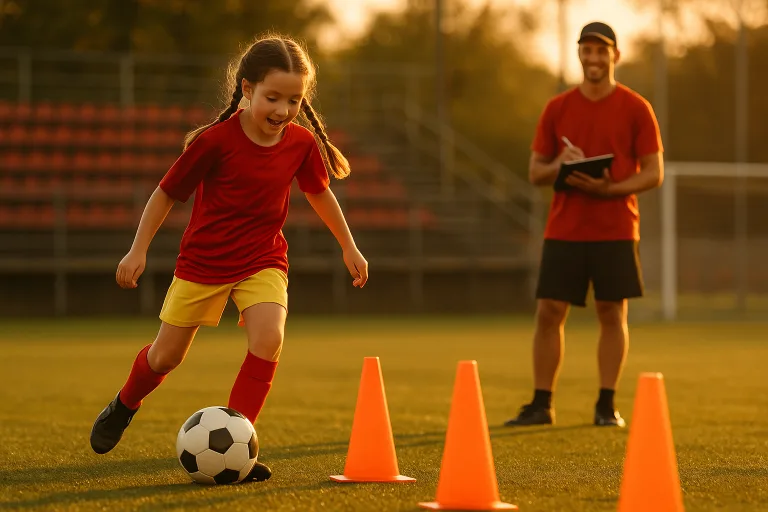
— Drills: ball mastery (inside/outside taps), cone slaloms, passing triangles, 1v1 challenges, small-sided scrimmages.
— Key tip: repeat simple technical moves under pressure; encourage creativity.
Ages 11–14 — Tactics, physical development, positional basics
— Session length: 60–90 minutes; 3–5 times/week including match play.
— Focus: tactical awareness, transition play, speed/agility, basic strength (bodyweight).
— Drills: tactical small-sided games, rondos, finishing drills, sprint + change-of-direction work, core & hip strength exercises.
— Key tip: balance skill repetition with game-like scenarios and recovery.
Sample weekly plans (examples)
— Ages 7–10: 2 team sessions (60 min), 1 fun technical session at home (20–30 min), 1 match or scrimmage on weekend.
— Ages 11–14: 3 training sessions (2 technique/tactics, 1 strength/agility), 1 match, 1 recovery/stretch session.
Practical drills and progressions
— Ball mastery progression: toe taps → inside/outside → pull-push → foundations of feints.
— Passing progression: short passing pairs → passing triangles → 4v1 rondo.
— Shooting progression: stationary finishing → volleys off a pass → finishing after dribble/turn.
— 1v1 progressions: attack vs. defend in small grid → add neutral player → apply in small-sided game.
— Warm-up: dynamic movements (leg swings, skips), short dribbles, passing in pairs.
Warm-up, injury prevention and recovery
— Always start with 8–12 minutes of dynamic warm-up.
— Emphasize ankle and knee strength (single-leg balance, gentle hops).
— Rest days and sleep are essential for growth (ages 11–14 need 9–10 hours/night).
— Ice acute injuries; seek medical attention for persistent pain.
Advice for parents
— Emotional support: praise effort and attitude, not just results. Encourage intrinsic motivation.
— Choose the right environment:
— Look for coaches who focus on development, positive discipline, and age-appropriate drills.
— Observe a session before enrolling: group size, coach communication, safety.
— Equipment checklist:
— Ball sizes